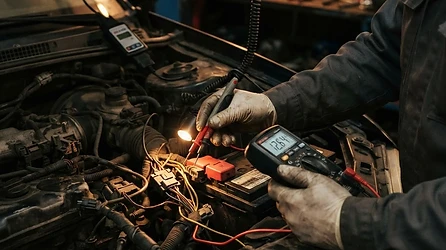
Battery & Charging System
Battery Keeps Going Flat? Help in Blackburn
A jump-start might get the car moving, but if the battery keeps going flat it’s worth finding out why. We help drivers across Blackburn work out whether it’s the battery, the charging system, a parasitic drain or a poor connection — before you spend money on parts that aren’t the problem.
Battery Keeps Going Flat
A battery that keeps going flat — overnight, after standing for a day or two, or after short trips — is a common and frustrating problem. The first assumption is often that the battery needs replacing, but the real cause may be elsewhere in the system.
Before replacing a battery, it’s worth finding out whether something is draining it, whether the charging system is working properly, and whether the battery itself is actually at fault. Swapping a battery that’s being drained by another fault will only help temporarily.
Parasitic Battery Drain
A parasitic drain is something that keeps drawing power from the battery when the vehicle is switched off. Every vehicle has a small background draw — the alarm, the clock, the keyless entry. But if that draw is higher than it should be, the battery will go flat over time.
Common sources of excess drain include aftermarket accessories (dash cams, trackers, stereos), faulty modules that don’t power down, interior lights that stay on, and relays that stick closed. We test for parasitic drain by measuring current draw with the vehicle at rest and isolating circuits to find the source.
Could It Be the Alternator?
If the alternator isn’t charging the battery properly while the engine is running, the battery will gradually go flat — even on a decent drive. Symptoms can include a battery warning light on the dashboard, dim headlights at idle, or the vehicle cutting out after being driven for a while.
We test alternator output voltage and check that the charging system is delivering the right current to the battery under different load conditions.
Poor Battery Connections
Sometimes the battery, alternator and wiring are all fine — but the connections at the battery terminals are loose, corroded or damaged. Poor connections can stop the battery charging properly, cause intermittent starting issues, and create voltage drops that affect the vehicle’s electrical systems.
Checking and cleaning battery connections is a straightforward but important part of charging-system diagnosis.
Other Things That Cause Flat Batteries
A few other things can cause a battery to go flat that aren’t a fault as such: lots of short journeys where the alternator doesn’t get enough running time to recharge, a vehicle that’s been left unused for a while, or simply an ageing battery at the end of its life. We’ll take these into account before recommending any work.
Battery Testing
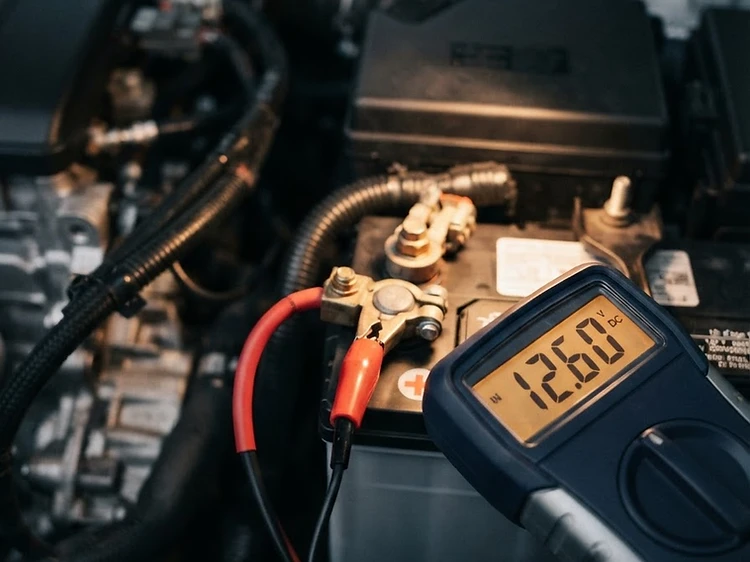
We test battery condition using proper testing equipment — not just checking voltage, but assessing the battery’s ability to hold and deliver charge under load. A battery may show 12V on a multimeter but still be unable to start a vehicle if its internal resistance is too high.
Stop-Start Battery Coding & Registration
Many modern stop-start vehicles use AGM or EFB batteries rather than a standard lead-acid battery. Fitting the correct type of battery matters, but on some vehicles the charging system also needs to be told that a new battery has been installed — a process usually called battery registration or coding.
If this step isn’t carried out, the battery management system may continue to treat the new battery as the old one. That can lead to stop-start no longer working, repeated low-battery warnings, charging behaviour that doesn’t seem normal, premature battery problems, or electrical faults returning shortly after a battery replacement. Not every vehicle requires battery coding, but it’s worth bearing in mind if a flat-battery or charging fault has come back soon after a new battery was fitted.
Charging-System Diagnosis
Charging-system diagnosis involves testing alternator output, checking the wiring between the alternator and battery, inspecting connections and earth points, and confirming the system is charging correctly under different electrical loads. This methodical approach identifies whether the fault is the battery, the alternator, the wiring or something drawing power when it shouldn’t be.
Related Services
Related Electrical Faults
Electrical faults often overlap. These related pages might also be relevant to your vehicle.
Mobile Auto Electrician
We come to your home, workplace or wherever the vehicle is parked for mobile electrical diagnosis.
Electrical Diagnostics
Proper fault finding for warning lights, intermittent issues and sensor problems.
Car Won’t Start
Help finding the cause when the car won’t start — battery, starter, charging, wiring or immobiliser.
Alternator & Starter
Diagnosing clicking, slow cranking and charging faults before any parts are replaced.
Related Guides
Plain-English Guides
Short, practical guides that go deeper on related faults.
FAQ
Frequently Asked Questions
Not necessarily. The battery might be fine, with the real problem being a parasitic drain, a charging-system fault or poor connections. We test the battery, the charging system and for parasitic drain before recommending replacement — replacing a battery that’s being drained by another fault will only help temporarily.
We don’t promise battery replacement without first confirming what the fault actually is. If testing shows the battery needs replacing, we’ll explain what’s needed. But our main role is diagnosis — finding the cause before recommending any parts.
We measure the current draw from the battery with the vehicle switched off and at rest, then isolate individual circuits to find which one is drawing more power than it should. This identifies the source of the drain rather than guessing.
Yes — aftermarket accessories wired to a permanent live feed are a common cause of parasitic battery drain. If an accessory was fitted around the time the battery problems started, tell us. It’s a useful clue.