Battery & Charging
Battery Keeps Going Flat — How Parasitic Drain Actually Works
A battery that keeps going flat while the vehicle is parked is a common and frustrating problem. The first instinct is often to replace the battery — but if something is draining it, a new battery will only help temporarily.
This guide explains how a parasitic drain is diagnosed in plain English. It does not instruct you to probe live circuits yourself — that is best left to someone with the right equipment.
The Basics
What parasitic drain means
Every modern vehicle draws a small amount of power while it is switched off — the alarm, the clock, the keyless entry system, the memory for the radio and seats. This is normal standby draw, and a healthy battery can supply it for weeks without going flat.
A parasitic drain is an abnormal draw — something pulling more power than it should when the vehicle is at rest. Over a day or two, that extra draw can flatten a battery that would otherwise be fine.
The key distinction is between a battery that has failed, a battery that is not being charged, and a battery that is being drained while parked. Each has a different fix. See our battery drain and charging faults page for the service side of this.
Common Sources
What can cause a drain
Aftermarket accessories and modules that do not switch off are the usual suspects.
- Dashcams wired to a permanent live feed
- USB chargers and aftermarket accessories left connected
- Trackers and security devices
- Boot, glovebox or interior lights that fail to switch off
- Modules that fail to “go to sleep” when the vehicle is locked
- Sticking relays
- Wiring faults that bridge a permanent supply to another circuit
- Aftermarket stereos, alarms or accessories not installed correctly
An alternator diode fault can also allow current to flow back through the alternator when the engine is off, flattening the battery while parked. It is less common than an accessory drain but worth knowing about. See alternator and starter motor faults.
How It’s Diagnosed
How a parasitic drain is diagnosed
A methodical process — not guessing, and not pulling things at random.
01
Confirm battery condition
Test the battery itself first. A battery that can no longer hold charge will keep going flat regardless of any drain.
02
Confirm the charging system
Check that the alternator is charging correctly while driving, so the battery is actually being topped up between uses.
03
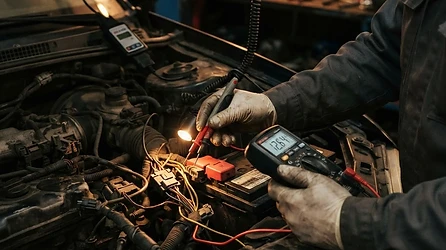
Measure key-off current draw
With the vehicle at rest and locked, measure how much current the battery is supplying. A higher-than-expected reading suggests a drain.
04
Allow modules to go to sleep
Modern vehicles can take several minutes after locking for systems to power down. Measuring too early gives a false high reading.
05
Isolate circuits
Pull fuses or disconnect circuits one at a time while watching the current draw, to narrow down which circuit is responsible.
06
Identify the component or circuit
Once the circuit is found, test the components on it to find the specific cause — a stuck relay, a failed module, a wiring fault.
Narrowing It Down
Is it the battery, a drain, or the charging system?
The pattern of when the battery goes flat is the biggest clue.
Probably the battery
- Battery is several years old
- Goes flat even after a good long run
- Fails a proper load test
- Voltage drops quickly under load
Probably a drain
- Goes flat while parked, fine when used daily
- Started around the time an accessory was fitted
- Current draw stays high when the vehicle is at rest
- No charging warning light
Probably the charging system
- Battery warning light on while driving
- Goes flat during use, not while parked
- Dim headlights at idle
- Voltage low while the engine is running
Why replacing the battery may not solve the real cause: if a drain or a charging fault flattened it, the new battery will go the same way. Testing the cause first avoids paying for a battery you did not need.
FAQ
Short FAQ — Parasitic Drain
A parasitic drain is anything that keeps drawing power from the battery when the vehicle is switched off and locked. Every car has a small normal standby draw — the alarm, clock and keyless entry. A parasitic drain is an abnormal draw that is higher than it should be.
Yes. A dashcam or other accessory wired to a permanent live feed can draw power while the vehicle is parked. If battery problems started around the time an accessory was fitted, it is a useful clue worth mentioning.
Not always. If the real cause is a drain, a charging fault or a poor connection, a new battery will only help temporarily. Testing the cause before replacing the battery is the sensible order.
Measuring key-off current draw accurately needs care and the right equipment, and probing around live circuits carries real risk. It is best left to someone with the proper tools. You can still help by noting exactly when the flat batteries started and what accessories are fitted.
Safety around battery testing
- Do not probe around battery terminals or live circuits without the right equipment
- Do not bridge, bypass or remove fuses to “test” a drain by guessing
- Accidentally shorting a battery terminal can cause burns or fire risk
- Leave current-draw measurement and circuit isolation to someone with proper tools
If you’re in East Lancashire
Battery keeps going flat and you’re in East Lancashire?
If you’re in Blackburn, Darwen, Accrington or the surrounding area, describe what the vehicle is doing and we can help you work out the next sensible step.