Non-Starting Vehicle Diagnosis
Car Not Starting? Mobile Diagnosis in Blackburn
‘It won’t start’ can mean a few different things. Tell us whether the engine turns over, whether you hear a click, whether the dashboard lights come on — those details can help narrow the fault down before we even get there. We’ll take a proper look and explain what’s likely going on.
‘It Won’t Start’ — What It Could Mean
A vehicle that won’t start could be doing any of the following, and each points to a different likely cause:
- Nothing happens at all when you turn the key — could be battery, wiring, immobiliser or starter
- A clicking sound — single click or rapid clicking — often battery, connections or starter circuit
- The engine turns over but won’t fire up — could be electrical, fuel, immobiliser or engine management
- Dashboard lights come on but the starter doesn’t operate — could be starter, wiring or immobiliser
- It starts after a jump but goes flat again later — likely a charging or drain problem
- It happens sometimes but not every time — often an intermittent connection or component
Not Every Non-Start Is Electrical
This is worth saying plainly. A vehicle that won’t start may have an electrical cause, but it could also be a fuel problem, a mechanical issue or something else entirely. We help work out whether the fault is electrical in nature.
If it turns out to be outside the scope of auto-electrical work — a fuel pump failure or a mechanical issue, for example — we’ll tell you honestly rather than trying a repair we can’t properly complete.
What to Tell Us Before the Visit
The more detail you can give, the better we can assess whether a mobile visit is suitable:
- Does the engine crank when you turn the key, or is there no response at all?
- Do you hear clicking — and if so, is it a single click or rapid clicking?
- When did it start — was it sudden or gradual?
- Has the battery been recently replaced, charged or jump-started?
- Are any warning lights staying on when you turn the ignition on?
- Has the vehicle been standing for a while, or was it being driven regularly?
What Happens During Diagnosis
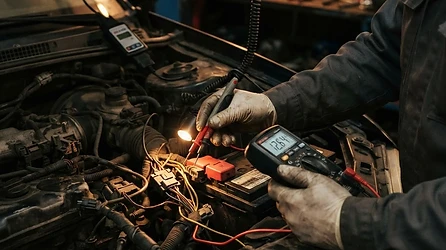
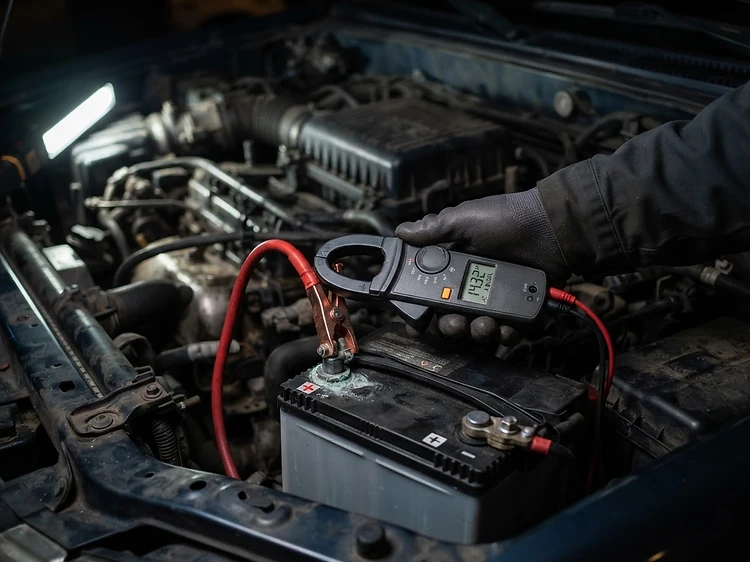
We start by testing the battery voltage and checking the charging system. If the battery and charging system are healthy, we move on to test the starter motor circuit, wiring and connections. If those are sound, we look at the immobiliser and related systems.
The aim is to find the cause methodically rather than guessing. That may involve testing at several points in the starting circuit to find where the current is being lost or interrupted.
When Workshop Facilities May Be Needed
If we find the fault and the repair needs a part that isn’t available straight away, or if the work involves extensive wiring repair that needs shelter and time, workshop facilities may be needed. We’ll explain this clearly if it applies to your vehicle.
Related Services
Related Electrical Faults
Electrical faults often overlap. These related pages might also be relevant to your vehicle.
Mobile Auto Electrician
We come to your home, workplace or wherever the vehicle is parked for mobile electrical diagnosis.
Electrical Diagnostics
Proper fault finding for warning lights, intermittent issues and sensor problems.
Battery & Charging
Finding why the battery keeps going flat — parasitic drain, charging faults and poor connections.
Alternator & Starter
Diagnosing clicking, slow cranking and charging faults before any parts are replaced.
FAQ
Frequently Asked Questions
Yes, for suitable faults and where there’s safe access to the vehicle. Tell us what the vehicle is doing when you try to start it — whether it cranks, clicks or does nothing — and we’ll work out whether a mobile visit is practical.
No. A flat or failing battery is the most common cause, but starter motor faults, charging-system problems, wiring issues and immobiliser faults can all prevent a vehicle from starting. We test each area to find the actual cause.
We’re an auto-electrical diagnosis service, not a recovery or jump-start service. If the battery is the issue, we can identify that and explain what’s needed. But our role is to find the fault, not to provide emergency jump-starts.
We’ll tell you honestly. If the non-start is caused by a fuel problem, mechanical issue or something outside auto-electrical work, we’ll explain what we’ve found and suggest an appropriate next step.