Warning Lights
Multiple Warning Lights Came On At Once — What It Usually Means
When several dashboard warning lights appear at the same time, it can look as though the whole car is failing. In practice, several lights together often point to one underlying issue rather than several separate failures.
This guide explains why several lights can appear together. It does not diagnose your specific vehicle — testing is needed to confirm the cause.
Why It Happens
Why several warning lights can appear at once
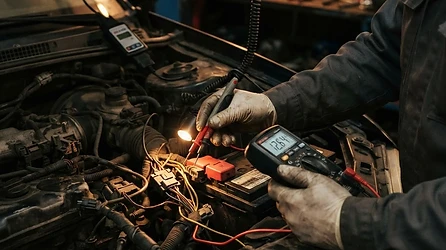
Modern vehicles are built around connected control modules that share power supplies, sensors and data networks. Because the systems talk to each other, a single fault can be reported by several modules at the same time.
A few common reasons explain most cases where multiple lights appear together:
- Several modules share the same power supply — low voltage affects all of them
- Several systems rely on the same sensor or input — one failed sensor can warn everywhere it feeds
- Modules communicate over a network (CAN bus) — a communication fault can trigger warnings across the network
- Stored fault codes can remain after an earlier voltage drop or event, even after the cause has gone
This is why several warning lights together often points to one cause rather than several separate failures. Read more about vehicle electrical diagnostics.
Common Causes
Common underlying causes
One of these often explains a sudden cluster of warning lights.
Low system voltage
A weak or discharged battery, or a charging fault, can drop system voltage low enough that several modules log warnings at the same time.
Charging fault
An alternator not charging correctly can leave the battery underpowered, which can trigger warnings across multiple systems.
Bad earth / ground
A poor earth point can cause strange dashboard behaviour and trigger warnings that seem unrelated to each other.
Shared sensor or input fault
A single sensor that feeds several systems — a wheel speed sensor, for example — can trigger ABS, traction and stability warnings together.
Communication / CAN issues
Modern vehicles share data between modules over a network. A communication fault can make several modules report problems at once.
One failed sensor, several warnings
Because systems share inputs, one failed component can be reported by every system that relies on it.
What To Do
A calm decision section
Use the colour and how the vehicle is behaving to choose a sensible next step.
Red / Flashing / Behaving Badly
Amber / Driving Normally
After a Flat Battery / Jump Start
Be Prepared
What to record before asking for diagnosis
- Which lights came on, and whether they are red or amber
- Whether any are flashing
- Whether the vehicle is behaving differently — rough running, heavy steering, reduced power, changed braking
- Whether the lights appeared after a flat battery, jump start or battery replacement
- Whether they appeared suddenly or built up over a few drives
- Outside conditions — wet weather, very cold, after a long run
- Any recent repair or electrical work
Good detail helps separate a single underlying cause from several separate faults. Read about battery drain and charging faults or the car won’t start guide.
FAQ
Short FAQ — Multiple Warning Lights
Not necessarily. Several modules often share the same power supply, sensor or data network, so one underlying issue can be reported by several systems at the same time. Testing is needed to confirm the actual cause.
Yes. Low system voltage is one of the more common reasons several lights appear together. A weak battery, a charging fault or a poor connection can all drop voltage low enough for multiple modules to log warnings.
It depends on the lights and how the vehicle is behaving. Red or flashing lights, or any change in how the vehicle drives, steers, brakes or reads temperature, means stop and assess safely. Amber lights with the vehicle driving normally can often be diagnosed soon rather than immediately.
A code reader can show which systems have logged faults, but codes point to circuits or systems, not always to the failed part. Several codes can trace back to a single cause, which is why testing matters before replacing parts.
Staying safe
- Do not ignore red or flashing warning lights, or any change in braking, steering or temperature
- If the vehicle is behaving strangely, stop somewhere safe before deciding what to do
- Do not attempt to bypass or disconnect safety systems
- Arrange professional diagnosis rather than clearing lights without understanding the cause
If you’re in East Lancashire
Still not sure what the symptoms mean?
If you’re in Blackburn, Darwen, Accrington or the surrounding area, describe what the vehicle is doing and we can help you work out the next sensible step.